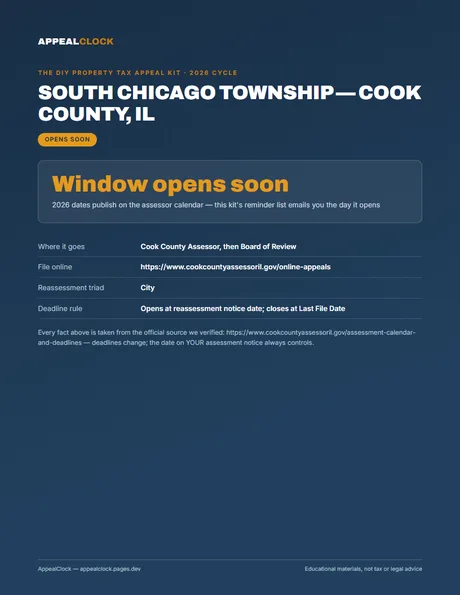
How South Chicago Township's reassessment cycle opens your window
Cook County reassesses properties on a triennial schedule divided into three geographic triads — City, North, and South. South Chicago Township sits in the City triad, which means its reassessment year is distinct from townships like Palos or Cicero, which fall in the South and North triads respectively. With a City triad reassessment now upcoming, this is the cycle to act — the Cook County Assessor will mail new assessed values to every South Chicago Township property owner, and that mailing starts your appeal clock.
The deadline isn't a fixed date you look up once and trust forever. The window opens when reassessment notices go out and closes at the Last File Date, which the Assessor publishes in the official assessment calendar. The deadline shown at the top of this page reflects the verified current dates — but the date on your notice and the calendar at cookcountyassessoril.gov are what legally govern. In non-reassessment years, grounds for appeal are narrow; in a reassessment year, every property owner has the right to challenge the new value on its merits. That right expires at the Last File Date with no extensions.
The 10% math — and why Cook County's equalization factor amplifies your savings
Illinois law sets the residential assessment level at 10% of fair market value. Cook County then multiplies your assessed value by the state equalization factor — a number the Illinois Department of Revenue sets annually to bring the county's average assessed value in line with the statewide standard of one-third of market value. The result is your equalized assessed value (EAV), and that's the figure your local tax rate is applied to.
The math means the multiplier works in your favor when you appeal. A reduction in appraised fair market value shrinks your assessed value at 10%, and then the equalization factor amplifies that reduction further when computing your EAV. In plain terms: a meaningful over-assessment produces EAV savings that exceed a simple 10% calculation. Because a successful appeal in a reassessment year typically holds for the entire three-year cycle until the next City triad reassessment, the compounding effect across multiple tax years makes even modest over-assessments worth contesting. The Cook County property tax appeal overview walks through the full EAV calculation with examples.
What wins at the Cook County Assessor and Board of Review
A South Chicago Township appeal runs through two independent decision-makers. The Cook County Assessor's office reviews first and can adjust the value administratively. If the result doesn't satisfy you, the independent Board of Review — a three-commissioner body separate from the Assessor — holds its own hearing. Both respond to the same categories of evidence:
- Comparable sales. Three to five sales of similar homes in or near South Chicago Township, at prices below your assessed fair market value, ideally from the year before the assessment date. This is the strongest evidence type for residential appeals and what both reviewers weight most heavily.
- Property record card errors. The Assessor's mass-appraisal model pulls from a record card that lists your home's square footage, bedroom and bathroom count, basement finish, and lot size. Data-entry errors are not rare — a single incorrect characteristic can overstate value by tens of thousands of dollars and is one of the fastest wins available. Pull your record card and verify every field.
- Condition and obsolescence evidence. Functional problems the mass model cannot see: deferred maintenance, proximity to an elevated rail line or industrial corridor, a structural issue documented by a contractor's estimate, or an unusable outbuilding. Photos and written estimates make these arguments concrete.
Organized presentation matters at both levels. Assessor staff and Board of Review commissioners process large caseloads; one clear summary page with numbered exhibits is more persuasive than the same evidence presented as a folder of unsorted printouts.
Filing: portal, mail, and what happens after
The Cook County Assessor's online portal at cookcountyassessoril.gov/online-appeals is the fastest filing route — it accepts your appeal immediately, timestamps the submission, and returns a confirmation number to save. A paper filing mailed to the Assessor's office is also accepted; the postmark by the Last File Date controls, so use a method that creates a postmark record.
After you file, the Assessor reviews and may issue a revised assessed value. If you accept it, the appeal closes there. If the Assessor's decision is unsatisfactory — or the value is unchanged — you have the right to escalate to the Board of Review during its scheduled South Chicago Township session window; those dates are shown in the filing panel above. The Board of Review hearing is a brief, evidence-focused session and requires no attorney. If the Board of Review result is still unsatisfactory, further escalation to the Illinois Property Tax Appeal Board (PTAB) or Circuit Court is available, though for most homeowners a partial win at the Board of Review — combined with the three-year assessment stability a resolved appeal provides — is the sensible stopping point.
South Chicago Township traps worth knowing before you file
Four local wrinkles catch property owners every cycle. First, the Assessor's reassessment notice is not a tax bill — it shows the value being set for the coming cycle, and contesting it now is the only way to lower the bill that arrives later. Once the bill issues, the assessed value is locked for that year.
Second, the reassessment year is your broadest window. In the two years between triennial reassessments, grounds for appeal are limited to demonstrable errors or documented changes in condition — a much higher bar. The upcoming 2026 City triad cycle is your widest opening in three years.
Third, Cook County homeowner exemptions — including the Homeowner Exemption, Senior Freeze Exemption, and others — are separate filings that do not apply automatically when you appeal. They carry their own deadlines and deliver savings on top of any appeal reduction. If you haven't confirmed your exemptions are active, check that in parallel with your appeal research.
Fourth, if South Chicago Township saw a large average increase in assessed values, don't assume the increase is uniform or accurate across individual parcels. Mass appraisal models apply neighborhood-level adjustments that miss street-by-street variation — an elevated transit corridor, a block facing industrial uses, or a pocket of deferred maintenance can justify values well below the township average. The Board of Review exists precisely to hear those property-level arguments.