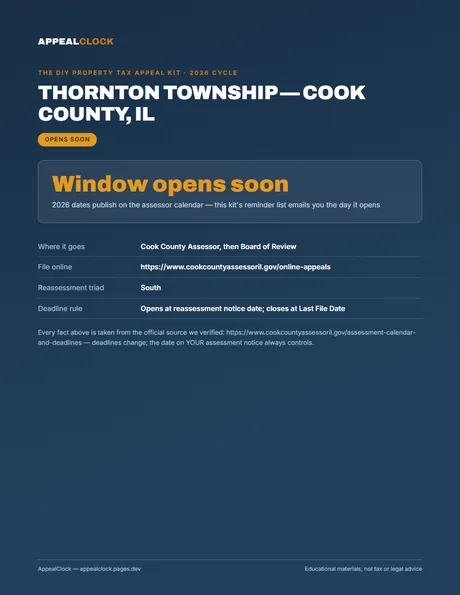
How Thornton Township's appeal window actually works
Cook County operates on a triennial reassessment cycle, and Thornton Township sits in the South Triad — meaning a full reassessment lands roughly every three years. Your appeal window opens alongside that cycle: once reassessment notices go out for Thornton, the countdown begins and closes on the Last File Date shown above. That date is published in the Cook County Assessor's assessment calendar; if the date on your individual notice differs, verify which controls before you act.
What makes Cook County distinct from most other Illinois counties is that you get two independent chances. The first is with the Cook County Assessor while the township window is open. The second is with the Board of Review — an independent three-commissioner body that operates on its own group schedule, separate from the Assessor's cycle. Filing now, before the deadline above, preserves both options. Let the Assessor's window close and you're down to one swing.
The 10% assessment math — and why it compounds in the south suburbs
Illinois law sets the assessment level for Cook County Class 2 residential property at 10% of fair market value. But that's only the first step. The state applies an annual equalization factor — the "multiplier" — to bring Cook County's total assessed values in line with the statewide one-third-of-market-value standard. Your Equalized Assessed Value (EAV) is assessed value times that multiplier, and your tax bill is EAV times your combined local levy rate.
In practical terms: a $20,000 reduction in your appraised market value becomes $2,000 in assessed value, which the state equalizer then amplifies before the levy applies. South-suburb homeowners often carry among the highest effective property-tax rates in the Chicago metro relative to home values — so the dollar impact of a successful appeal is larger here than almost anywhere else in the region. A corrected value isn't a one-time event; it repeats each year the lower figure holds.
What evidence wins at Cook County appeals
Both the Assessor's office and the Board of Review respond to the same core evidence. Three categories carry the room:
- Comparable sales. Arm's-length sales of homes near yours — similar square footage, age, and condition — that closed before your assessment date at prices below what your assessed value implies about fair market value. This is the backbone of nearly every successful residential appeal.
- Property record errors. Pull your Cook County property record card and verify the listed square footage, bedroom and bathroom count, basement finish, and lot size. Mass-appraisal models carry clerical errors forward for years; a few hundred square feet of overcount can inflate your value by tens of thousands of dollars, and correcting it is often the fastest win available.
- Condition evidence. Photographs and contractor estimates for anything the mass model can't observe — foundation problems, water damage, deferred maintenance on major systems, or unusable outbuildings. The model rates your property class and neighborhood; it can't see your specific problems.
Bring organized evidence. A one-page summary of your comparable sales beats a folder of screenshots — both the Assessor's reviewers and the BOR panel reward homeowners who make the decision easy.
Filing: portal, mail, and what happens at each stage
The Cook County Assessor's online portal is the fastest path: it timestamps your complaint instantly and returns a confirmation number you can save. You can also mail a written complaint to the Assessor's office — the postmark date is your proof, so mail from the counter, not a drop box. Either way, filing is free.
After you file, the Assessor's office reviews the evidence and issues a decision — a revised value or a confirmation of the original. That isn't the end of the road. Any owner who filed with the Assessor (or received a new assessment notice this cycle) can file a separate complaint with the Board of Review during its group window. The BOR is independent of the Assessor's staff and frequently reaches different conclusions on the same evidence. Beyond the BOR, you can escalate to the Illinois Property Tax Appeal Board (PTAB) or the Circuit Court, though for most Thornton Township homeowners a BOR result — or the savings from a partial win — is the practical stopping point.
South-triad traps Thornton Township homeowners hit every cycle
Three patterns catch homeowners in Thornton and neighboring South Triad townships each cycle. First, the reassessment notice is not a tax bill. It shows the value you can contest; actual tax bills arrive later, when the appeal window is already closed. Don't wait for the bill to move. Second, the Assessor appeal and the Board of Review appeal are separate filings with separate deadlines — filing with the Assessor doesn't carry your case to the BOR automatically. You must file independently during the BOR's group window. Third, homestead exemptions — the General Homestead, Senior Freeze, Disabled Persons Exemption, and others — have their own annual deadlines and don't flow through an appeal. Many Thornton Township homeowners leave hundreds of dollars in annual exemption savings unclaimed while focused entirely on the assessed value.
For the full picture of Cook County's triennial system, the BOR process, and the exemption calendar, see the Cook County property tax appeal guide. Neighboring South Triad townships follow the same two-step structure; the Palos Township and Cicero Township pages cover their group-specific windows.