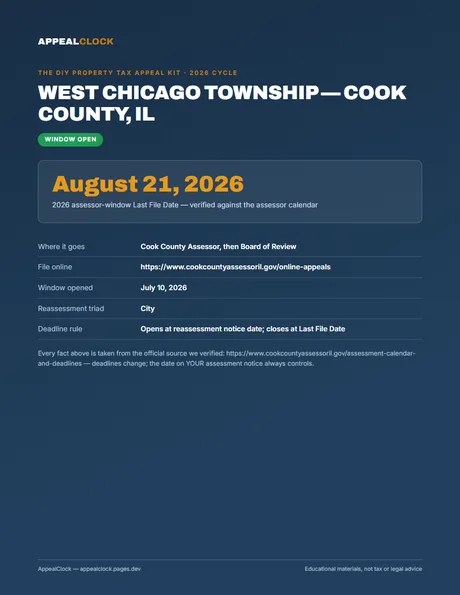
How the Cook County appeal window works for West Chicago Township
West Chicago Township sits in Cook County's City triad, which means your neighborhood is reassessed on a three-year cycle. When the Assessor publishes new values for your triad, the appeal window opens — and it closes on the Last File Date shown in the band above. That date controls, not a generic county calendar, so verify your specific deadline at the Assessor's calendar page if you have any doubt.
Miss the Assessor's window and you still have one more shot: the Board of Review holds its own independent hearing period for City triad parcels. That BOR window is shown above as well. If you're reading this while the Assessor's window is still open, act now — the BOR round is narrower and requires a separate filing. For a full picture of how Cook County structures these two tiers, see the Cook County property tax appeal guide.
The 10% math that decides whether appealing is worth your afternoon
Illinois law (35 ILCS 200/9-145) requires residential property in Cook County to be assessed at 10% of fair market value. Your tax bill is then calculated on that assessed value after the state equalization multiplier — the annual "factor" published by the Illinois Department of Revenue — is applied to produce the Equalized Assessed Value (EAV), which is what the local tax rate actually hits.
Concrete example: if the Assessor pegs your West Chicago home at $350,000 market value and comparable sales support $300,000, you've argued away $50,000 — reducing your assessed value by $5,000. Multiply that by Cook County's current equalization factor and your composite tax rate to see the dollar savings. Importantly, a successful appeal also resets the baseline for the remaining years of the triennial cycle, so one afternoon of paperwork can protect you across multiple tax years, not just the current bill.
What actually wins at the Cook County Assessor and Board of Review
Both the Assessor's review and a BOR hearing respond to organized evidence. Three categories carry the most weight:
- Comparable sales. Three to five homes in West Chicago Township with similar size, age, and condition that sold below your assessed market value in the period before your notice date. This is the backbone of nearly every winning residential appeal.
- Property record errors. Pull your property record card from the Assessor's site and check square footage, bedroom and bathroom count, garage size, and lot dimensions. Data entry mistakes are common and are the fastest wins available — an error costs nothing to correct.
- Condition evidence. Photographs and contractor estimates for problems a mass-appraisal model can't detect: foundation cracks, roof damage, flood exposure, or a deteriorating outbuilding. The Assessor's model assumes average condition; documented deficiencies below that baseline are a direct argument for a lower value.
One organized summary page beats a folder of printouts. The evidence standard at the BOR is the same as at the Assessor level, but the panel is independent — so if you were denied at the first tier with solid comps, the BOR is a genuine second hearing, not a formality. See how neighboring townships handle the same process in our Cicero and Palos pages.
Filing: portal, paper, and what happens after
The fastest path is the Cook County Assessor's online appeals portal — it timestamps your submission instantly and generates a confirmation number you can save. If you prefer paper, the Assessor's office accepts written filings as well; a USPS postmark by the Last File Date is your proof, so request one at the counter rather than relying on a metered stamp.
After the Assessor's review, you'll receive a decision. If the revised value is acceptable, the process ends there. If not — or if you were denied outright — you have a separate right to file with the Board of Review during the BOR window shown above. The BOR is a three-member independent panel; its hearing period for West Chicago Township's City triad Group 3 is in the filing table on this page. A BOR hearing remains free for residential filers, and the panel's decision is binding for the remaining years of the cycle unless you escalate to the Property Tax Appeal Board (PTAB) or Circuit Court — paths that typically make sense only for higher-value disputes.
Cook County traps that catch West Chicago homeowners every cycle
Four local wrinkles are worth knowing before you file. First, the triennial reassessment means City triad parcels get a fresh look every three years — but the Assessor can also issue adjustments in off-years, so don't assume last year's value is locked in. Second, filing an appeal does not suspend your tax bill; you pay on the Assessor's current value while the appeal is pending and receive a refund or credit if you win. Third, homeowner exemptions — Homeowner, Senior, and Senior Freeze — are filed on a separate deadline entirely. An appeal doesn't apply them retroactively, and they can reduce your bill by hundreds per year on their own; check the Assessor's exemption page while you're already in the system. Fourth, if your block was reassessed en masse, don't assume the increase is untouchable — mass appraisal models miss street-level obsolescence, micro-location issues, and individual condition problems, which is precisely what the BOR is designed to hear.