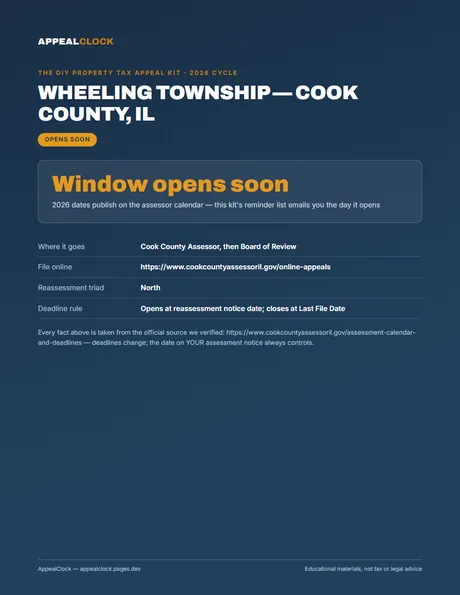
How Wheeling Township's triennial cycle shapes your window
Wheeling Township is part of Cook County's North Triad, which means the Assessor reassesses every parcel here once every three years — not annually. When your reassessment notice arrives, the filing window shown in the deadline band above is the only administrative appeal opportunity until the next North Triad cycle. Miss it and you're locked into the Assessor's value, plus any incremental adjustments, until reassessment comes around again.
The deadline rule is straightforward: the window opens when your reassessment notice is issued and closes at the Last File Date for Wheeling Township. Cook County can mail notices in batches, so the date printed on your notice controls — don't rely on a neighbor's timeline or a countywide estimate. Verify your specific deadline at the Cook County Assessor's calendar.
The 10% assessment math and why a successful appeal compounds over three years
Illinois law sets Cook County residential property (Class 2) at an assessment level of 10% of estimated fair market value. The state then applies an equalization factor — the "multiplier" — to bring each county's assessed values up to the statutory standard of one-third of fair market value. The result is your Equalized Assessed Value (EAV), and that's the figure your local tax rate is applied to before exemptions are subtracted.
The leverage matters: every dollar of market value you remove through a successful appeal becomes roughly $0.10 of assessed value, which after the state multiplier translates to roughly one-third of a dollar of EAV reduction. Because Wheeling is on a three-year cycle, that lower base holds through the remainder of the triennial period — the savings don't reset annually. At suburban Cook County tax rates, the accumulation over three years is meaningful.
Before filing anything else, verify your homestead exemptions. The Cook County property tax appeal overview covers the General Homestead Exemption, Senior Homestead Exemption, and Senior Freeze — each reduces your EAV directly and runs on its own spring deadline that an appeal doesn't extend.
What actually moves a Cook County Board of Review panel
If the Assessor's review doesn't produce a satisfying reduction, the Board of Review is your second shot — an independent body that decides without deference to the Assessor's conclusion. Three categories of evidence carry the most weight:
- Comparable sales. Three to five arms-length sales of homes similar to yours in or near Wheeling Township, sold within the year before the reassessment date, that support a lower market value. This is the backbone of nearly every winning residential appeal.
- Property record errors. Pull your PIN's record card from the Assessor's website and check square footage, bedroom and bathroom count, basement classification, and lot size. Mass appraisal models process thousands of parcels and characteristic errors are not rare — a documented discrepancy is often the fastest route to a reduction.
- Condition evidence. The Assessor's model can't see a foundation issue, an unusable outbuilding, or a roof that needs replacement. Photos and contractor estimates put those facts on the record where they can shift value.
Organize your evidence on one page. The Board of Review hears many appeals each session; a clear, concise presentation of comps and any record errors is more persuasive than a thick folder of unsorted screenshots.
Filing: two chances under Cook County's two-stage process
Cook County gives property owners two distinct opportunities to challenge an assessed value in a reassessment year. The first is with the Cook County Assessor — file online through the Assessor's portal before the deadline on your notice. The portal timestamps your submission and generates a confirmation; if you file by mail, preserve the postmark as your proof.
After the Assessor reviews your appeal, one of three outcomes follows: the value is reduced to your satisfaction, it's reduced but not enough, or it's unchanged. In the second and third cases, you file a separate appeal with the Board of Review — a different body with its own filing window, shown in the filing panel on this page. Missing that BOR window after an unsatisfying Assessor result forfeits your second administrative chance this cycle.
The BOR conducts hearings where you walk through your comparable sales and any record errors. If the BOR result still leaves the value too high, further appeal to the Illinois Property Tax Appeal Board (PTAB) or Circuit Court is possible, though most homeowners find that a successful Assessor or BOR reduction — combined with applicable exemptions — brings the bill to an acceptable level.
Wheeling Township traps that catch filers every cycle
Four local patterns catch North Triad homeowners every reassessment year.
The triennial window is unforgiving. Annual-assessment counties give you another opportunity next year. In Wheeling Township, missing the deadline above means living with the Assessor's value until the next North Triad cycle. The countdown above represents a real constraint that doesn't exist in most other states.
Your reassessment notice is not your bill. The notice establishes the value that can be contested; the actual tax bills arrive later, after taxing districts set their rates. The appeal window closes long before those bills land in your mailbox.
Two-stage means two separate filings. An appeal to the Assessor does not place your case before the Board of Review — that's a second, independent submission with its own deadline. Many homeowners lose the BOR window simply by not knowing it existed or assuming the first filing covered both stages.
Exemptions run on a parallel track. An appeal targets your estimated market value; exemptions reduce your EAV directly. Both matter, and each has its own deadline. Check both tracks this cycle rather than treating them as alternatives.
Other Cook County townships that follow the same Assessor → Board of Review process are covered in our Cicero Township guide and the Palos Township guide — each township's reassessment calendar differs, but the two-stage structure is the same countywide.