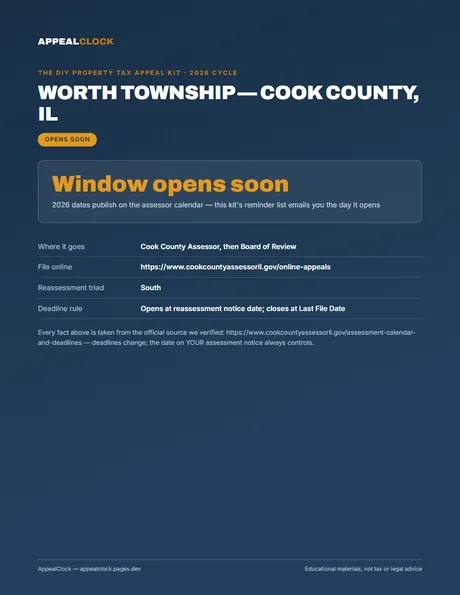
How the appeal window works in Worth Township
Cook County runs a triennial reassessment system: every parcel gets formally revalued once every three years, and Worth Township falls in the South Triad. That means this is the cycle when your value is most exposed to change — and when contesting it carries the most leverage, because a corrected value holds for the rest of the three-year period. When the Cook County Assessor mails your reassessment notice, the clock starts. The deadline shown above is the Last File Date; miss it and you wait until the next cycle.
What separates Cook County from most Illinois jurisdictions is its two-stage structure. The Assessor's window is first — file there, get a decision, and if you don't accept it, your case moves to the Board of Review, which opens a separate South Triad window (the 2025 session dates are shown in the panel above). These are independent bodies with independent deadlines. Filing with the Assessor doesn't lock you into any outcome; it simply starts the process. Verify the current calendar at cookcountyassessoril.gov.
The Illinois assessment math that decides whether appealing pays off
Illinois law targets a 33.33% assessment level, but Cook County uses a two-step method to reach it. The Assessor assigns Class 2 residential property (most single-family homes) an assessed value equal to 10% of estimated market value. Then the Illinois Department of Revenue applies a state equalization factor — the Cook County multiplier — to bring the county's aggregate level up to the statutory target. The result is your Equalized Assessed Value (EAV), which your local tax rate is applied to.
In practice, the multiplier amplifies the effect of a successful appeal. A $50,000 reduction in your appraised market value becomes a $5,000 cut in assessed value, and that figure is then multiplied by the current year's equalizer before the tax rate applies. In south suburban Cook County, where combined tax rates rank among the highest in Illinois, that math adds up quickly — and it holds for every year until the next reassessment rather than just one bill. The Cook County appeal overview explains how EAV and tax rates interact across the county's different tax districts.
What actually wins at the Cook County Board of Review
Both the Assessor's office and the Board of Review decide on evidence, not frustration. Three categories move the needle in residential cases:
- Comparable sales. Three to five closed sales near your property — similar size, age, and condition — that occurred before the assessment date and support a lower market value. This is the backbone of most winning Cook County residential appeals.
- Property record errors. Pull your property characteristics from the Assessor's portal and check square footage, bedroom and bathroom count, garage type, and lot size. A data-entry error in a mass-appraisal model covering hundreds of thousands of parcels is not unusual, and a documented error is among the fastest wins available.
- Condition evidence. Photos and written estimates for deferred maintenance, structural issues, or damage that the Assessor's field reviewer didn't observe. If your property would sell for less than nearby comps because of an actual condition problem, document it clearly.
Organize everything on one or two pages. Board of Review reviewers process high volumes; a clearly labeled summary wins faster than an unstructured folder. The Cicero Township page has notes on evidence formatting that apply equally to Worth Township hearings.
Filing: Assessor portal, Board of Review, and what happens in between
The Cook County Assessor's online portal at cookcountyassessoril.gov/online-appeals is the fastest path — it timestamps your submission immediately and lets you upload comparable sales and evidence directly. File before the Last File Date shown above. The Assessor reviews your submission and may issue a revised value. If you accept, the matter is closed. If you don't, your case moves automatically into the Board of Review's South Triad window without you having to start over.
The Board of Review is a separate county agency — not the Assessor's staff — and it conducts its own review with its own hearing process. You can submit updated or additional evidence at this stage. If the BOR result is still unsatisfactory, further escalation is available through the Illinois Property Tax Appeal Board (PTAB) or Circuit Court, though for most residential parcels in Worth Township, a corrected value at either stage — held through the end of the triennial period — is the practical endpoint where the numbers make sense.
South Triad traps that catch Worth Township homeowners every cycle
Four wrinkles catch people repeatedly in reassessment years. First, the reassessment notice is not your tax bill — it shows the value you can contest, while the actual bill arrives months later when the appeal window has already closed. The timeline is earlier than most homeowners expect. Second, Cook County's two-stage process means two separate deadlines: missing the Assessor's window doesn't end your options if the Board of Review window is still open, but missing both does. Third, homestead exemptions — General Homestead, Senior Freeze, and others — are filed separately with their own deadlines and are not automatically applied when you win an appeal; check yours at the county level while you're already engaged. Fourth, South Triad parcels being reassessed en masse this cycle are especially worth scrutinizing: the model revaluing your neighborhood was trained on countywide data and routinely misses street-level factors — teardown adjacency, traffic noise, lot irregularities — that actual buyers price in. Neighboring Palos Township homeowners face the same dynamic this triad; see the Palos Township page for how the same issues play out one township over.